In 2026, I was the Guest Editor for Women's Art Register Bulletin on the theme of Solidarity. The text below is the editorial I wrote to accompany the online publication. The publication includes articles by Kaye Abude, Kiera Brew Kurec, Safa El Samad, Juundaal Strang-Yettica and Amy Spiers, George Criddle and Lana Nguyen.
Full publication is available here
Full publication is available here
SOLIDARITY IS IN THE AIR!
This edition of the Bulletin addresses the theme of Solidarity. It is a word that has been circulating around in my brain and my practice for a few years now. I come to solidarity by way of anger, frustration, fear and disillusionment at a world that seems to be spinning out of control. In the face of war, colonisation, genocide, rising fascism, poverty and the impending climate catastrophe, solidarity is an idea that gives me hope. It is an idea that feels constructive, that moves beyond rage and inspires us to get together and get organised.
In January this year, while attending the Invasion Day rally, I was struck by the words of Tarneen Onus Browne who said:
In January this year, while attending the Invasion Day rally, I was struck by the words of Tarneen Onus Browne who said:
“It's not enough to be angry. It's not enough to go to protests, and it's not enough to be outraged. You need to sign up and organize collectively. That means joining your union. That means joining together for Treaty. That means supporting community radio and local arts and media. We have to connect with each other outside of social media…This is the only way that we can beat them and we can. We have shown it through history. We can only do that by sticking together and organising, not just being outraged. But we can do this together…”
This idea of coming together in real space is not new. It has been part of collective organising for a long time. Yet in the digitised age of social media, gathering in person can take on a novel tone. I often think about the collective power of feminist consciousness raising groups from the 1970s, where women gathered in small groups, often at home, to share personal experiences and connect them to bigger structural issues. Together these women read texts, made art, listened to others and created a local, political and emotional networks, supporting each other and encouraging each other to take action. I wonder how we can harness this form of gathering now? Consciousness-raising comes up frequently in one of my favourite podcasts, ACFM (Acid Communism FM) by Novara Media, as an antidote to the failures of neo-liberalism, a way to combat feelings of isolation, nihilism and despondency.
Learning from history is an important element of solidarity. The legacy of consciousness-raising encourages us to listen, to share and speak out, to be in a collective space with each other and learn from both the political and personal to create a better future. And, it is in this act of coming together where art can play an important role. Art can create a space to gather, to listen to learn and to take action.
This edition began by asking: How are women/nonbinary artists manifesting solidarity through their practices? What does a feminist politics /art look like when it moves beyond the women's movement into the broader political realm? How does it encourage us to ask different questions about structures of power and offer ways to question these structures? How can it build new forms of community and why do we need this now? It has taken shape through a series of inspiring conversations that have pushed me to think about solidarity in new ways. It has encouraged me to question the role of solidarity in art and the role the arts can play more broadly.
Solidarity is not one thing, and there are many pathways to building solidarity, both large and small. Solidarity swims around in different ways, through different communities, through time and space. It is slippery, messy and difficult to pin down. This elasticity allows it/us to be responsive, it provides the ability to shift, to listen and to stand up for what we believe, and this is what makes us stronger. The fluidity of solidarity can be found here in this collection of texts. There are many overlapping themes, and each reading offers new insight, new pathways and new connections.
I am reminded of an old saying told to me by 3CR Chairperson Pilar Aguliera “Remember the past, to understand the present and change the future.” It is through this lens I have chosen to think about the contributions to this edition. Running through these texts, common themes and interests emerge: the role of history, the importance of memory, the legacy of failure, the importance of community and of gathering, and of course a call to action. This collection reminds me that actions can take many forms, that even the smallest gesture can make a difference.
We start with the past, as this is an archival publication. History permeates all the texts. Family stories, monumental myth making, struggles of class, war, colonisation and dispossession. To build a better future, we must remember the past. History and archives are important. They are where stories and national identities are formed and possibly be re-formed in ways that break down old tropes and build new progressive futures.
Remembering history in new ways is an act of solidarity. When done as a collective and embedded with care, remembering can be a powerful act. Both Kay Abude and Kiera Brew Kurec highlight this. Kay Abude’s Notes on Labour: Radical Women reminds us that “women’s solidarity = community solidarity”, that our strength to care, to support and to act is in the collective. There are multiple acts of solidarity taking place here, both in the history of the Miners’ Women’s Auxiliary and in the contemporary act of collective remembering.
Collective remembering also underpins Kiera Brew Kurec’s performance work They Carried Soil Under their Nails. Through song, movement and engagement with land and the body, Brew Kurec’s work connects members of the Kurec family in an act of collective remembering. It reminds us of the importance of storytelling, cultural practice and relating histories in a time when Ukrainian culture is under constant threat from russia’s war with Ukraine. Here and in Brew Kurec’s writing, the use of the lower case ‘r’ is itself an act of resistance to russian imperialism, an act of solidarity with Ukrainian people through language.
The importance of family history is the foundation for Safa El Samad’s piece Three Sisters Walk into a Grocery Store. Her and her sister’s memories lead us to the present, and to the creation of Dukkana, a new collective space in Coburg. Dukkana–the Arabic word for grocery store – is an example of how art can be a powerful force for finding new moments of solidarity through gathering. Dukkana’s activities are a melting pot of ideas brought together through a “shared ethos of community and accessibility”. At Dukkana one can discuss the present, and dream of new futures, free from the burdens of bureaucracy and institutions.
Imagining new futures brings us to the writing of Juundaal Strang-Yettica and the conversation between Amy Spiers, George Criddle and Lana Nguyen. These visions for the future are informed by the past and offer us ways to rethink our relationships to land, nationality and a shared responsibility. In different ways, these two text call us to action.
For Juunndaal Strang-Yettica, the archive becomes an active space for building relationships, where Aboriginal and non-Aboriginal people can learn from Aboriginal cultural knowledge. In “acts of co-care”, “multiple outcomes” are possible and “retro-accountability” can move us to act in solidarity with the land, and each other, for the betterment of both human and non-human kin in acts of co-care.
For Amy Spiers, George Criddle and Lana Nguyen, the call to action takes a different form. Through their discussion, the artists offer a “score” for settler responsibility, one with multiple entry points to think, respond and act. This may include embracing failure or acknowledging the “cringe” as methods for finding new ways to grapple with so-called Australia’s uncomfortable history.
There are many paths to tread through this edition, and many connections to be found. I would encourage you to take your own journey or, better yet, do it with others. Taking a cue from the Readers and Writers Against Genocide and feminist consciousness-raising groups, find some friends, read together, discuss and share ideas and take action.
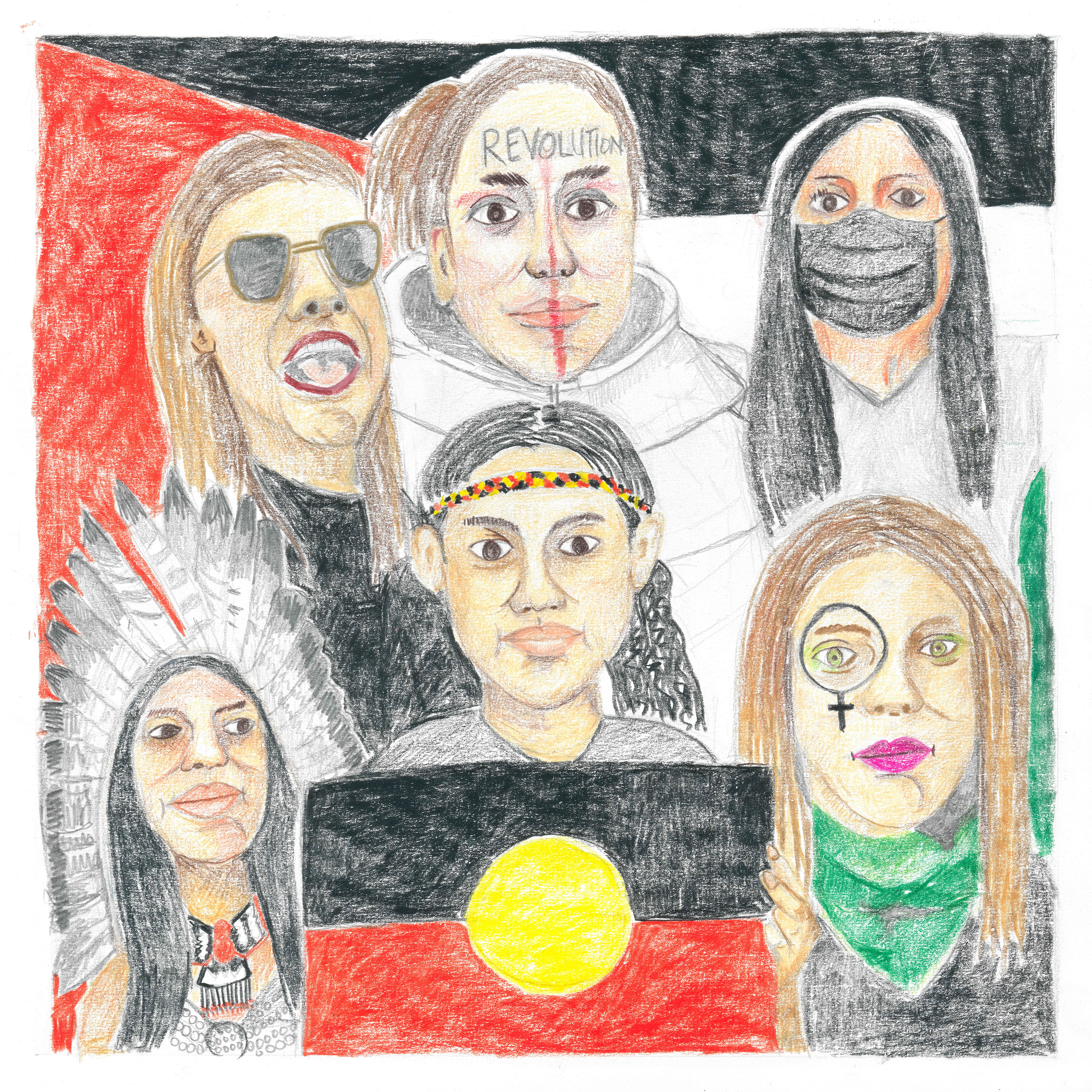
Nasty Women, (2024), pencil on paper, 400mm x 400mm
Art can be a tool for healing and regeneration. Art will be the tool that can bring us together to reflect on our shared history. Art will be how we celebrate our difference and what brings us together. It will be how we will resolve our political oppositions and how we work towards a more fair and equitable future for all. Art will be how we commemorate our victories, mourn our dead and tell our history. Art will be how we create understandings, how we talk to each other and how we listen. Art will be how we care for our elderly, our children, our homeless, our disadvantaged and our environment. Art will be how we imagine a new shared future together.”
Excerpt, Katie Sfetkidis, A Message from the Mayor, video, 2021
Excerpt, Katie Sfetkidis, A Message from the Mayor, video, 2021